1/11/26 Gilly’s Blog
Organic farming and phenotypic expression
-How a living soil system allows cannabis to fully express themselves
I practice indoor gardening by building living systems. I don’t feed my plants. My focus is soil biology, environmental controls, and plant signaling. I let the plant do the work while I manage the conditions.
Plants know what they want, and they know when they want it. Cannabis plants, specifically, are often limited by our cultivation methods more than by their own physiology. Plants use exudates, sugars and organic compounds released through their roots, to “pay” microbes and fungi for nutrients. This exchange only happens when the biology in the soil has been allowed to establish itself.
In a salt-heavy, ionically charged environment, the plant is being force fed soluble nutrients. Because those nutrients are immediately available, the plant has no reason to expend energy producing exudates or participating in biological exchange. And like everything in nature, plants will always take the path of least resistance. If nutrients are handed to them, they stop asking for help.
This is where phenotypic expression starts to matter.
Each cultivar has its own unique traits; aroma, flavor, structure, color, resin production. We all recognize this. But those traits only fully emerge when the plant is truly “happy,” not just surviving. Look at a COA from any testing facility. You won’t see one or two terpenes. You’ll often see twenty or more, many present in very small amounts. Those minor compounds are not noise. They’re communication tools. Stress responses. Defensive signals. Internal regulators. They’re the language plants use to interact with their environment and protect themselves.
For a plant to fully express that language, it cannot be constrained.
When we rely on force fed ions, we suppress the very mechanism that allows expression to happen. Reduced exudation leads to reduced microbial interaction, which in turn limits nutrient complexity and signaling pathways. The plant may grow fast. It may look healthy. But it’s operating in a simplified system, not a complete one.
Organic, living soil removes that constraint.
In a biologically active soil, nutrients are not dumped into solution all at once. They’re mineralized, exchanged, and delivered as the plant requests them. Exudates increase. Microbial diversity expands. Fungal networks mature. The plant is no longer reacting to inputs, it’s directing them. This is when expression deepens. Aromas become layered. Resin profiles sharpen. Structural traits stabilize. The plant stops compensating and starts performing.
My role as a grower isn’t to push nutrients into a plant. It’s to build an environment where the plant doesn’t need to be pushed at all. True synergy at a microscopic level.
This is part one of my blog here with Bud Rich Radio. I love my team, and I love my plants. This blog will be where I pour out my love for organics and cannabis. All of my innovations and projects will come together here to help you better understand how indoor organic gardening helps create the perfect environment for full phenotypic expression. Stay tuned and follow along with Budrich Radio.
One Love!
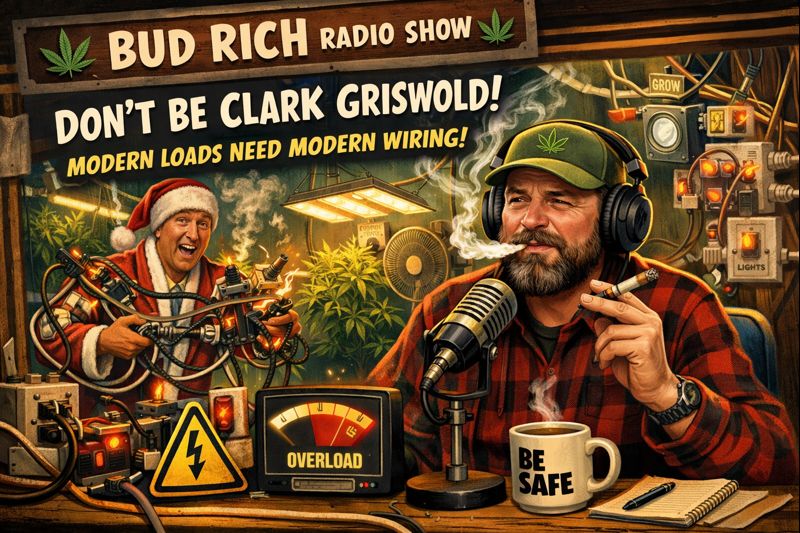
Modern Loads, Old Wires: Why Your Extension Cord Is the Weakest Link
By JayDee the Hashishin
Every December, someone watches A Christmas Story or National Lampoon’s Christmas Vacation and laughs at Clark Griswold nearly burning his house down by plugging half the Midwest into one outlet.
And every year—quietly, less funny—people do the exact same thing in their basements, spare bedrooms, garages, and tents… except instead of Christmas lights, it’s grow lights, dehumidifiers, heaters, fans, controllers, and automation gear.
You’re not Clark Griswold.
And this isn’t 1983.
Modern equipment needs modern wiring.
15 Amp vs 20 Amp: The Difference People Pretend Doesn’t Matter
Let’s start with the basics—because this is where most bad decisions begin.
A 15-amp extension cord is usually:
- Thinner wire (often 16 or 14 gauge)
- Designed for intermittent loads
- Meant for lamps, TVs, holiday lights, phone chargers
- Absolutely not meant to run hot, continuously, for 12–18 hours a day
A 20-amp extension cord:
- Uses thicker copper (12 gauge)
- Handles sustained load better
- Stays cooler under stress
- Is designed for tools, compressors, heaters, and—yes—grow equipment
Here’s the thing nobody likes to hear:
If your equipment can pull serious power, the cord needs to be thicker than you think—not thinner.
The breaker doesn’t trip because a cord is overheating.
The cord just melts quietly until something bad happens.
The Christmas Tree Problem (And Why It Keeps Happening)
Most electrical disasters don’t start at the wall.
They start between the wall and the load.
Here’s the classic bad setup I’ve seen more times than I can count:
- Lights plugged into a power strip
- Power strip plugged into a timer
- Timer plugged into a cheap extension cord
- Extension cord plugged into the wall
That’s not a circuit.
That’s a Christmas tree of failure points.
Each connection:
- Adds resistance
- Creates heat
- Becomes a potential melt point
- Was never designed to carry full load continuously
And when something fails, it’s never the breaker.
It’s always the weakest plastic component in the chain.
“But It’s Made for Growing” — The Most Dangerous Sentence
I’ve done this one myself.
I walked into a grow shop years ago and bought a surge protector + timer combo. It was marketed for growing. It looked legit. It had outlets everywhere.
So I plugged four Spider Farmer G8600s into it.
And I melted the timer.
Not instantly. Not dramatically.
Just slowly, quietly, until it failed.
That’s when it hit me:
If that device were actually meant to handle that load, it would have needed to be a 30-amp unit with a junction box, not a plastic power strip.
“Made for growing” doesn’t mean “made for your grow.”
Why Extension Cords Aren’t the Enemy (Bad Ones Are)
There’s this myth that extension cords are inherently unsafe.
They’re not.
Cheap, undersized, loosely run extension cords are unsafe.
A properly chosen extension cord:
- 12 gauge (or thicker)
- Rated for 20 amps
- Short as possible
- Properly secured to walls
- No tight coils
- No foot traffic
- No heat sources nearby
…is often safer than the wiring inside your walls, especially in older homes.
You can literally make it better than the house wiring by using heavier copper.
When an Extension Cord Makes Sense
Use a heavy-gauge extension cord when:
- You need flexibility
- You’re renting
- The run is temporary
- You’re testing or scaling
- You need to isolate loads cleanly
Think of it like a temporary branch circuit, not a workaround.
When You Just Need to Bite the Bullet and Install a Subpanel
There’s a point where clever turns into stupid.
If you’re running:
- Multiple high-draw lights
- Dehumidifiers
- Heaters
- AC units
- Automation systems
- Pumps and controllers
…and you’re stacking cords, strips, and timers…
It’s time for a subpanel.
Yes, it costs more.
Yes, it feels like overkill.
No, it is not optional if you want long-term safety.
A subpanel:
- Gives you dedicated breakers
- Eliminates chained failure points
- Scales cleanly
- Makes troubleshooting easy
- Keeps heat where it belongs—inside rated hardware
Sometimes the safest solution is the boring one.
Automation Doesn’t Reduce Load — It Concentrates It
This is another trap.
Timers, controllers, smart plugs, surge protectors—none of them reduce electrical demand. They just organize it.
And when you concentrate load into a device that wasn’t designed for it, it fails first.
Automation gear is often rated for:
- Small tents
- Single lights
- Hobby setups
Not full-tilt, modern LED arrays pulling serious amperage.
Always check the actual amp rating, not the marketing.
The Simple Rule That Saves Houses
If you remember nothing else, remember this:
Modern loads demand modern wiring paths.
That means:
- Fewer connections
- Thicker copper
- Shorter runs
- Rated hardware
- Proper mounting
- Heat awareness
If your setup looks like a Christmas tree, it’s wrong.
If it looks boring, overbuilt, and slightly excessive—
you probably did it right.
Final Thought from the Hashishin
I’ve gone down the rabbit hole of over-engineering, dreaming up rolling sub boxes, industrial connectors, RV feeds, Tesla chargers, and Frankenstein setups.
And after all that?
Sometimes the right answer is:
- One heavy-gauge cord
- Or one properly installed subpanel
- And zero clever bullshit in between
Electricity doesn’t care how confident you feel.
It only cares about copper, heat, and time.
Don’t be Clark Griswold.
Be boring. Be safe. Be bud rich—and house intact. 🌲⚡